Listen while you read:

AVRO Baroque around the Clock
Non-stop barokmuziek
Free 256k audio stream
Showing posts with label afghanistan. Show all posts

11.27.2010

Afghans, "What's 9/11?"


Daniel Tencer

Fewer than one in 10 Afghans are aware of the 9/11 attacks and their precipitation of the war in Afghanistan, says a study from an international think tank.

A report (PDF) from the International Council on Security and Development (ICOS) shows that 92 percent of those surveyed had never heard of the coordinated multiple attacks on US soil on September 11, 2001. It also shows that four in 10 Afghans believe the US is on their soil in order to "destroy Islam or occupy Afghanistan."

To be sure, the survey can't claim to be definitive: It only canvassed men, and relied primarily on respondents from Helmand and Kandahar, the two most war-torn provinces in the country. But the results nonetheless show that Western forces fighting insurgents in Afghanistan have largely failed to connect with the local population.

“We need to explain to the Afghan people why we are here, and both show and convince them that their future is better with us than with the Taliban,” ICOS lead field researcher Norine MacDonald said in a statement.

The survey also suggests that Afghans are skeptical of their own government's ability to protect them, and have little regard for the fledgling democratic institutions the country is building. Fully 43 percent could not name one positive aspect of democracy, and nearly two-thirds -- 61 percent -- said they didn't think Afghan forces would be able to keep up the fight against the Taliban if and when Western forces withdrew.


The ICOS study recommends a publicity campaign to explain to Afghans why foreign forces are fighting on their soil. The think tank also proposes a number of other initiatives meant to improve the image of foreign forces in the country, including having NATO forces deliver humanitarian aid where aid groups fear to travel, providing farmland to the poor, setting up women's councils, and "safe village convoys" which would see foreign troops escort villagers in dangerous rural areas.

ICOS has a permanent presence in Afghanistan and has been studying the nearly decade-long war's impact on Afghan society. The think tank has previously proposed that Afghanistan license the growing of opium. The group argues that eliminating the opiate trade from Afghanistan is virtually impossible due to its entrenched place in the culture. At the same time, Afghan farmers could earn money by selling opiates to painkiller manufacturers.

Opponents of the idea say that Afghanistan is not stable enough to develop a proper opium-manufacturing industry, and a licensing scheme would only encourage the sale of opium to heroin manufacturers.

8.01.2010

Endgame in Afghanistan [Significant Video]


By Sean Smith, Michael Tait, Guy Grandjean and Alex Rees
As the war in Afghanistan enters its final chapter, Sean Smith's brutal, uncompromising film from the Helmand front line shows the horrific chaos of a stalemate that is taking its toll in blood. Warning: the clip contains distressing scenes and strong language.
Guardian film-maker and photographer Sean Smith has just spent five weeks in Afghanistan, first with a US helicopter ambulance crew, and then with the US marines. This is his astonishing diary of his time with special forces.


2/06/2010

At 8.30am I leave Kandahar US airbase on a flight with the Guardian Angels; these are specially trained US air force helicopter pilots who fly into combat areas to pick up the injured. Accompanying them are the "jumpers", the armed paramedics who will jump out and get the wounded – or the bodies. There's also a gunner who mans the machine guns as the helicopter lands.

They are working 12-hour shifts. Mostly they are watching movies, doing emails. Today there was a class on how to treat burns.

3/06/2010

In the morning we pick up a US soldier who has been shot in the face and chest on patrol. We're hit by two rounds of gunfire shot through the underneath of the helicopter. To take out the helicopter when it comes in to pick up the wounded soldier – that's the real prize.

The injured guy was on the verge of passing out and couldn't move his face or say anything because his cheek had been shot away, and his airways were blocked. He survived. Later on, we pick up another soldier who had lost two legs and an arm. He made it too.

4/06/2010

Pick up an Afghan lorry driver caught by an IED (improvised explosive device).

5/6/2010

Pick up an Afghan soldier who has shot himself in the foot.

6/06/2010

We are called out to a soldier who has stepped on a mine. We land, as there is no one shooting at us. He has lost an arm and a leg but still has a pulse. The medics are doing emergency resuscitation. We are only in the air five minutes and they are pumping and pumping and still going at him on the stretcher as he is taken off the copter. He doesn't make it.

8/06/2010

I am at Camp Bastion with the British and am trying to fly to Nadi Ali. But the first flight is full. They get me on a Lynx helicopter later for Bastion, with the letters and parcels for the troops.

20/06/2010

I'm in Dand district, near Kandahar city. I'm with the US army and we're supposed to go out at 8am to talk to locals, to do the hearts-and-minds stuff. The problem is that the Afghan national army who are with us don't speak Pashtun; they only speak Dari. So the Americans end up doing all the talking through a translator – which is missing the point of what we are supposed to be doing. The American medic passes out in the heat and is sick twice. It's over 50C.

22.06.2010

Road-opening ceremony. It was in one of the little villages where they are paying Afghans to build roads. We drive off the tarmac in case of IEDs. When we get there, there are lots of young men standing around with brand-new blades and picks, paid for by the Americans. They have clearly never been used. There's no new road.

The governor has even come down from Kabul to make a speech. We only stay 15 minutes because the whole thing is rubbish. The lieutenant colonel is very angry.

25/06/2010

Three soldiers are brought in today injured at a nearby deserted school by an IED. Even in this "stable" area all the schools are deserted. None of the kids is going to school. I leave for Kandahar base. Continued...

7.28.2010

Wiki Leaks is Old News


By Chris Floyd
These leaked "bombshells" will simply bounce off the hardened shell of American exceptionalism, which easily ustifies the slaughter of civilians, "targeted killings", "indefinite detention" and any number of other atrocities.

The much ballyhooed dump of intelligence and diplomatic files concerning the Afghan War has been trumpeted as some kind of shocking expose, "painting a different picture" than the official version of events -- revelations that are sure to rock the Anglo-American political establishments to their foundations.

The New York Times, The Guardian and Der Spiegel were given 92,000 reports by Wikileaks, including thousands of pages of raw "human intelligence."

That is, uncorroborated claims and gossip from interested parties and anonymous sources pushing a multitude of agendas.

They diplomatic notes passed between the promulgators of the occupation in Washington and their factotums "in country" -- reports which you might imagine also purvey a multitude of agendas ... not least the supreme agenda of all officials involved in a dubious enterprise: ass-covering.

Yet these reports are being treated as if they are the "grim truth" behind the shining picture of official propaganda. But what do these stories in the NYT and Guardian actually "reveal"? Let's see:

* That the occupation forces kill lots of civilians at checkpoints and botched raids, then lie about it afterward.

* That these killings make Afghans angry and fuel the insurgency.

* That elements of Pakistani intelligence are involved with some elements of the many resistance groups known collectively (and incorrectly) in the West as the Taliban.

* That the Americans are using more and more robot drones to kill people.

* That the Americans are running death squads in Afghanistan aimed at Taliban leaders.

* That Afghan officials are corrupt, and that Afghan police and military forces are woefully inadequate.

Is there anything in these breathless new recitations that we did not already know? How does this alter the prevailing conventional wisdom about the war?

It doesn't, of course. These leaked "bombshells" will simply bounce off the hardened shell of American exceptionalism, which easily justifies the slaughter of civilians, "targeted killings", "indefinite detention" and any number of other atrocities. In fact, I predict the chief "takeaway" from the story will be this:

American forces are doing their best to help the poor Afghans, but the ungrateful natives are too weak and corrupt to be trusted, while America's good intentions are also being thwarted by evil outsiders.


Getting this message out via "critical" stories in "liberal" publications is much more effective than dishing up another serving of patriotic hokum on Fox News or at a presidential press conference.

In fact, it is so much more effective that one almost begins to wonder about the ultimate provenance of the leaks. Did some deep-delving gamester allow these files to get out? Most likely not; but their ultimate effect does provoke the age-old question, cui bono?

The assumption is that these 92,000 files about the Afghan war were obtained by an American private serving in Iraq, the unfortunate Bradley Manning, who is now under arrest for the "crime" of leaking something far more disturbing than any written document. That was a video showing the slaughter of Iraqi civilians by American Apache helicopters in 2007 [see above].

Washington knows that a couple of moving pictures on the tee-vee have a far greater potential to disturb the moral sleep of the American people than tens of thousands of newspaper reports -- or leaked documents -- detailing similar killings.

That said, in the end the Apache video has had zero effect on public perceptions of the Iraq War, which most people believe is "over," or on public support for the murderous machinations of the Terror War in general, which most people believe needs to continue in one form or another, to "keep us safe."

The only kind of grim truth attended to by anyone in America these days is that which can be shown in moving pictures. (Although the number of people who are upset even by that seems to be rapidly diminishing. That's why Manning had to be put away.

I don't question the bravery or sincerity of Manning or of Julian Assanage in bringing the latest material to light. And I suppose on balance it is better to have it than not to have it.

But I still question the usefulness of rolling out mountains of raw "human intelligence".

It's precisely the same kind of unfiltered junk that was "stovepiped" to build the false case for the mass-murdering invasion of Iraq -- about Iran, al Qaeda, Pakistan; even North Korea gets into the mix.

None of this can be checked -- but all of it will be extremely useful to those who want to build cases for more and more military action, death squads and covert actions around the world.

And it seems very odd that intelligence reports and bureaucratic memos by forces carrying out a prolonged, brutal military occupation of another country are now being treated by "liberal" media outlets as holy writ.

It claims to paint a "true" picture of the war -- a picture that omits any reference to American war-related corruption, for instance, not only in Afghanistan but more especially in Washington, or to America's wider "Great Game" machinations in Central Asia, involving pipelines, strategic bases and "containing China," etc.

Nothing will come of this document dump. It won't lead to the prosecution of even one single person for a war-related crime, or to a genuine debate over the morality of the war in the political and media establishments. There won't be a rise in public opposition to the Terror War project.

If any of that happened I would rejoice, and embrace the flashy packages of the NYT, Guardian and Der Spiegel at their own self-inflated valuation.

I believe the net effect will be simply to entrench the conventional wisdom about the war in the halls of power and in the echo chambers of opinion on both sides of the Atlantic.

We have already seen far too many atrocities, brutalities and acts of criminal folly countenanced, when they are not actually praised, far too many times -- over and over and over again -- in the course of the last decade to believe that these disgorgings of junk intelligence and apparatchik memos will make any difference.

Any difference for the better, that is. For I believe they will supply plenty of ammunition to those bent on further murder and plunder.

7.27.2010

Military Leaks Exposes US Atrocities


By Alex Lantier

The occupation of Afghanistan is a filthy imperialist war. Popular resistance and protests are drowned in blood and US death squads operate at will under a media blackout. NATO collaborates with an elite of corrupt warlords and Afghan officers.


On Sunday, the WikiLeaks web site posted 91,731 American military documents on the US-NATO occupation of Afghanistan, covering the period from January 2004 to December 2009.

The release was timed to coincide with articles on these revelations in the New York Times, the British Guardian and the German weekly magazine Der Spiegel, all of which had received the documents several weeks ago.

The documents make clear that the occupation of Afghanistan is a filthy imperialist war. Popular resistance and protest demonstrations are drowned in blood, US death squads operate at will under a media blackout, and Washington and NATO collaborate with a narrow elite of corrupt warlords and Afghan officers.

The documents were released as the Afghan government confirmed that NATO rocket fire last week killed more than 50 civilians, largely women and children, in the Sangin district of Helmand Province. The attack was one of the worst since the May 2009 Gerani air strike, in neighboring Farah province, which killed 140 civilians, including 93 children and 28 women.

The WikiLeaks documents confirm the massive scale of US-NATO repression. By the American military’s own classification, which downplays the role of US and NATO troops, the release includes 13,734 reports of “friendly action” by US-NATO forces.

There are 27,078 reports of “enemy action” and 23,082 of “explosive hazards”. This shatters claims that the Afghan resistance is the product of a few Al Qaeda terrorists. There are 237 reports of popular demonstrations against the US occupation or US-controlled Afghan authorities.

These documents themselves are reportedly only a small selection of millions of US files uploaded to WikiLeaks databases.

What has already been released, however, makes clear that the US military sees Afghan casualties as unimportant, to be dealt with primarily by relying on the Western media to conceal the scope of the killing from the populations in NATO countries and internationally.

According to one report, on March 28, 2007, Dutch forces fired on Chanartu, a village in Kandahar province that was reportedly under Taliban attack.

They killed four and wounded seven Afghan villagers in an operation the report called “justified.”

It said the Dutch government had “engaged in a proactive public relations campaign to prevent political fallout here and in the Netherlands,” explaining that otherwise Dutch soldiers might “hesitate” to fire on Afghans in the future. The killings were classified as the result of action by “enemy” forces.

Written from the standpoint of the US military in the heat of events, the documents often understate Afghan casualties.

For example, the September 2009 Kunduz bombing—when German officers called in a US air raid on two fuel trucks, killing 142 Afghans, overwhelmingly civilians—is listed as having caused 56 insurgent deaths.

The documents contain countless reports of civilians shot for approaching NATO vehicles, or for failing to stop at checkpoints.

This includes two instances in 2008 where NATO forces machine-gunned a bus—once by French troops, wounding eight, and once by US forces, with 15 casualties.

There are also repeated accounts of NATO forces repressing demonstrations, often in close coordination with local Afghan authorities.

On May 11, 2005 a unit of Marines reported demonstrations in Jalalabad, in eastern Afghanistan. After requests for help from the regional governor, Din Mohammed, the Marines called in “AH-64s [Apache attack helicopters] for a show of force.”

Under cover of air support, Afghan and UN forces moved against the demonstrators. Though the US military reported 37 Afghan civilians were killed and 10 wounded, it classified the Jalalabad demonstration as a “non-combat event” by “neutral” forces.

The documents also reveal the existence of Task Force 373—a covert, heavily-armed Special Forces death squad that mounts operations throughout Afghanistan, seeking to assassinate Taliban leaders.

On the night of June 11, 2007, while trying to capture Taliban commander Qarl Ur-Rahman near Jalalabad, Task Force 373 was surprised by a friendly Afghan police patrol which shone a light on them in the darkness.

The task force called in an air raid by an AC-130 gunship which blasted the policemen with cannon fire. Seven Afghan police were killed and four wounded.

One week later, Task Force 373 launched another mission, against Abu Laith al-Libi in Paktika province. The plan was to fire a salvo of six missiles at the village of Nangar Khel, where al-Libi was suspected of hiding, then send in troops to attack the village.

Though they did not find al-Libi, they discovered that the missile strike had killed six adults, whom they described as Taliban fighters, and eight Afghan children in a madrasa.

On October 4, 2007, the task force attacked Taliban forces in the village of Laswanday, only 6 miles from Nangar Khel. During a pause in the fighting the Taliban slipped away.

However, Task Force 373 called in an air raid, killing four civilian men, one woman, and one girl. Two teenage girls and a boy, as well as 12 US soldiers, were wounded. There are suspicions that some of the Afghan villagers were executed, as one of the men was found with his hands tied behind his back.

Coalition forces initially put out a statement claiming US forces had killed several Taliban militants. A US contingent visited the village and sought to blame the deaths on the villagers.

According to the leaked reports, they “stressed that the fault of the deaths of the innocent lies on the villagers, who did not resist the insurgents and their anti-government activities.”

The documents also reveal growing NATO losses in the air, including numerous drones and even manned aircraft, with at least one F-15 fighter being lost over Afghanistan.

In an April 2007 report, the US military cited reports that the Iranian government had purchased portable anti-aircraft missiles from the Algerian government and given them to Afghan insurgents. This has not been previously reported.

7.20.2010

Obama Goes Orwell, War is Peace


By John Pilger
In "1984", George Orwell described a superstate, Oceania, whose language of war inverted lies that "passed into history and became truth. 'Who controls the past,' ran the party slogan, 'controls the future: who controls the present controls the past.'"
Obama is the leader of a contemporary Oceania. In two speeches at the close of the decade, the Nobel Peace Prize-winner affirmed that peace was no longer peace, but rather a permanent war.


One that "extends well beyond Afghanistan and Pakistan" to "disorderly regions, failed states, diffuse enemies."

He called this "global security" and invited our gratitude. To the people of Afghanistan, which the U.S. has invaded and occupied, he said wittily: "We have no interest in occupying your country."

In Oceania, truth and lies are indivisible. According to Obama, the American attack on Afghanistan in 2001 was authorized by the United Nations Security Council.

There was no UN authority. He said that "the world" supported the invasion in the wake of the September 11, 2001, attacks. In truth, all but three of 37 countries surveyed by Gallup expressed overwhelming opposition.

He said that America invaded Afghanistan "only after the Taliban refused to turn over Osama Bin Laden." In 2001, the Taliban tried three times to hand over Bin Laden for trial, Pakistan's military regime reported, and they were ignored.

Even Obama's mystification of the 9/11 attacks as justification for his war is false. More than two months before the twin towers were attacked, the former Pakistani diplomat Niaz Naik was told by the Bush administration that a U.S. military assault would take place by mid-October.

The Taliban regime in Kabul, which the Clinton administration had secretly supported, was no longer regarded as "stable" enough to ensure U.S. control over oil and gas pipelines to the Caspian Sea. It had to go.

Obama's most audacious lie is that Afghanistan today is a "safe haven" for al-Qaeda's attacks on the West.

His own national security adviser, James Jones, said in October that there were "fewer than 100" al-Qaeda operatives in Afghanistan.

According to U.S. intelligence, 90 percent of the Taliban are hardly Taliban at all, but "a tribal localized insurgency [who] see themselves as opposing the U.S. because it is an occupying power." The war is a fraud. Only the terminally gormless remain true to the Obama brand of "world peace."

- - - - - - - - - - - - - - - -

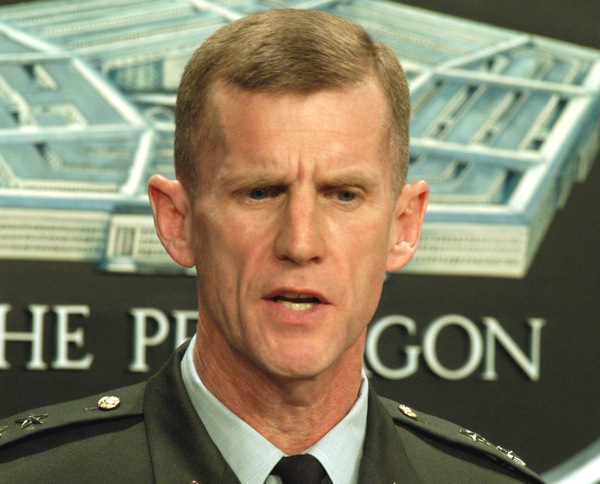
BENEATH THE surface, however, there is serious purpose. Under the disturbing Gen. Stanley McChrystal, who gained distinction for his assassination squads in Iraq, the occupation of Afghanistan is a model for those "disorderly regions" of the world still beyond Oceania's reach.

This is known as Coin (counter-insurgency), and draws together the military, aid organizations, psychologists, anthropologists, the media and public relations hirelings. Covered in jargon about winning hearts and minds, it aims to incite civil war: Tajiks and Uzbeks against Pashtuns.

The Americans did this in Iraq and destroyed a multi-ethnic society. They built walls between communities which had once intermarried, ethnically cleansing the Sunnis and driving millions out of the country.

Embedded media reported this as "peace"; American academics bought by Washington and "security experts" briefed by the Pentagon appeared on the BBC to spread the good news. As in 1984, the opposite was true.

Something similar is planned for Afghanistan. People are to be forced into "target areas" controlled by warlords, bankrolled by the CIA and the opium trade. That these warlords are barbaric is irrelevant.

"We can live with that," a Clinton-era diplomat once said of the return of oppressive sharia law in a "stable," Taliban-run Afghanistan.

Favored western relief agencies, engineers and agricultural specialists will attend to the "humanitarian crisis" and so "secure" the subjugated tribal lands.

That is the theory. It worked after a fashion in Yugoslavia, where ethnic-sectarian partition wiped out a once-peaceful society, but it failed in Vietnam, where the CIA's "Strategic Hamlet Program" was designed to corral and divide the southern population and so defeat the Vietcong--the Americans' catch-all term for the resistance, similar to "Taliban."

Behind much of this are the Israelis, who have long advised the Americans in both the Iraq and the Afghanistan adventures.

Ethnic cleansing, wall-building, checkpoints, collective punishment and constant surveillance--these are claimed as Israeli innovations that have succeeded in stealing most of Palestine from its native people.

And yet, for all their suffering, the Palestinians have not been divided irrevocably and they endure as a nation against all odds.

The most telling forerunners of the Obama Plan, which the Nobel Peace Prize-winner and his general and his PR men prefer we forget, are those that failed in Afghanistan itself.

The British in the 19th century and the Soviets in the 20th century attempted to conquer that wild country by ethnic cleansing and were seen off, though after terrible bloodshed.

Imperial cemeteries are their memorials. People power, sometimes baffling, often heroic, remains the seed beneath the snow, and invaders fear it.

"It was curious," wrote Orwell in 1984, "to think that the sky was the same for everybody, in Eurasia or Eastasia as well as here. And the people under the sky were also very much the same--everywhere, all over the world...

"People ignorant of one another's existence, held apart by walls of hatred and lies, and yet almost exactly the same--people who...were storing up in their hearts and bellies and muscles the power that would one day overturn the world.

7.06.2010

Did McChrystial Want Out?


By Immanuel Wallerstein

McChrystal's Chief of Operations, Maj. Gen. Bill Mayville, says Afghanistan will be like Vietnam: "It's not going to look like a win, smell like a win or taste like a win....This is going to end in an argument."

Hastings ends his article this way: "Winning, it would seem, is not really possible. Not even with Stanley McChrystal in charge."

So, what would you do if you were McChrystal? You'd invite a reporter for a rock-and-roll magazine, considered to be on the left, to accompany you on airplanes and to drink fests, and sneer at the government.

This was guaranteed to get you fired. And it meant that the future "argument" would not involve you.

What could Obama do? He had to fire McChrystal. Then, he tossed the hot potato to Petraeus, who couldn't refuse it.

The next year or two are going to be a fast-moving game in which Obama and Petraeus are going to try to shift the public's blame for the defeat on the other.

Gen. Stanley McChrystal, the U.S. commander in Afghanistan, gave an interview to Rolling Stone magazine in which he and his staff insulted the civilian leaders of his country.

He was fired for insubordination by Pres. Obama. Even his defenders said that McChrystal's remarks were impolitic and a mistake. Given the fact that McChrystal is an exceptionally intelligent and very ambitious person, why did he do it?

McChrystal gave the interview in order that he be fired. And why did he want to be fired? He wanted to be fired because he knew that the policies he was pursuing and championing in the war in Afghanistan were not working, could not work. And he didn't want to be the one tarnished with the public blame.

Consider the long history that led up to this interview. The military strategy the United States forged in Afghanistan and Iraq was originally that imposed by then U.S. Secretary of Defense, Donald Rumsfeld.

The policy was one of unlimited machismo. Bomb the enemy from way up high and don't worry about who gets killed. Use torture on those you capture. Don't consult with anyone, even if they are so-called allies. Occupy the country, indefinitely.

Stanley McChrystal was a one-star general at the beginning of these wars, working in Washington as one of Rumsfeld's "golden boys."

He had a long history, since his West Point days, of being a daring rebel who knew just when to stop -- contemptuous of superiors he did not respect but always seeking to advance himself.

Rumsfeld placed him in charge of the military's most secretive elite units, engaged in "special operations" and known to be a "killing machine." He performed brilliantly, as usual.

Then in 2006, if we still remember, the military, the politicians, and the press all began to say that the United States was losing the war in Iraq.

Resistance seemed too strong, and the number of U.S. lives lost was steadily going up month by month. The Republicans did very badly in the elections of 2006. Something had to be done.

Something was done. Rumsfeld was fired by President Bush. Vice-President Cheney, Rumsfeld's strongest defender, lost influence to Sec. of State Condoleezza Rice and Rumsfeld's successor, Robert Gates, who championed more "moderate" views, emphasizing diplomacy.

A new military strategy suddenly gained ground, counter-insurgency (referred to by an acronym COIN). It was developed by a previously obscure military officer, David Petraeus.

Petraeus is as ambitious and as driven as McChrystal but a quite different personality. He is what might be called a military intellectual. He won the award as the top graduate of the U.S. Army Command and General Staff College in 1983. He got a Ph.D. in international relations from Princeton in 1989.

He taught international relations at West Point. At the same time, he has a long record as a seasoned combat officer. And he cultivated favor with Washington politicians.

Since the 1980s, his published articles and reports advocated counter-insurgency as a doctrine. He drew on the experiences of the French using it in Algeria and the United States using it in Vietnam.

As Petraeus' right-wing critics note, these were not notable successes. COIN emphasizes the need for "winning hearts and minds," which means necessarily incorporating diplomatic and political considerations into military tactics.

The writer of the Rolling Stone interview, Michael Hastings, described COIN this way: "Think the Green Berets as an armed Peace Corps."

Pres. Bush turned to Petraeus in 2006 and allowed him to implement COIN in Iraq. This was the famous "surge" that involved increasing the number of U.S. troops in Iraq and changing strategy.

Basically, Petraeus did two things that did indeed reduce the amount of violence against U.S. troops.

The first was to bribe Sunni tribal elders in central and western Iraq to cease their tacit support of non-Iraqi al-Qaeda units. Since the Sunni sheikhs had never liked the al-Qaeda units, they were willing to forget their dislike of the Americans - for a price.

The second thing that Petraeus did was to permit ethnic cleansing in Baghdad, turning a multi-ethnic city into two segregated zones, a larger Shi'a zone and a beleaguered smaller Sunni zone.

This reduced violence against the U.S. troops at the expense of increased inter-Iraqi violence. It also served the political interests of the most persistent and effective opponent of U.S. interests in Iraq, Mokhtar al-Sadr, who is emerging as the key broker in the newly-elected Iraqi parliament.

As Hastings said in an interview with the Huffington Post about his article, "Petraeus is sort of a genius. He managed to turn what could have been catastrophic defeat in Iraq into a face-saving withdrawal." But of course, a face-saving withdrawal is not a victory, even if Sen. John McCain insisted so when running for president in 2008 -- unsuccessfully.

When Barack Obama ran for office, he said quite clearly that he was against the war in Iraq and for the war in Afghanistan. So obviously he had to pursue it.

He promoted Petraeus, adopted COIN, and named McChrystal commander in Afghanistan. True to his "rebel" style, McChrystal publicly demanded 40,000 more troops from Obama who, after months of reflection, gave him 30,000 -- plus a withdrawal date.

At this point, however, McChrystal abandoned his previous machismo style and became the enthusiastic, perhaps over-enthusiastic, implementer of counter-insurgency in Afghanistan.

He issued super-strict directives to avoid civilian casualties, a policy not at all appreciated by U.S. infantry units. He developed warm relations with Pres. Hamid Karzai, whom other U.S. leaders held at a distance.

He thought he could win a quick victory in Marja and turn the area over to Afghan forces. Instead, it was a failure. And he recently announced that the key operation in Kandahar province, heartland of the Taliban forces, had to be postponed until September.

Even McChrystal's Chief of Operations, Maj. Gen. Bill Mayville, says Afghanistan will be like Vietnam: "It's not going to look like a win, smell like a win or taste like a win....This is going to end in an argument."

Hastings ends his article this way: "Winning, it would seem, is not really possible. Not even with Stanley McChrystal in charge."

So, what would you do if you were McChrystal? You'd invite a reporter for a rock-and-roll magazine, considered to be on the left, to accompany you on airplanes and to drink fests, and sneer at the government.

This was guaranteed to get you fired. And it meant that the future "argument" would not involve you.

What could Obama do? He had to fire McChrystal. Then, he tossed the hot potato to Petraeus, who couldn't refuse it.

The next year or two are going to be a fast-moving game in which Obama and Petraeus are going to try to shift the public's blame for the defeat on the other.

The far right, the friends of Cheney and Rumsfeld, are not fooled. Diana West, one of their pundits, says: "The COIN nightmare continues."

For her, COIN means ordering troops "to exercise fantasies of cultural relativism that makes lefty sense in a PC classroom, but are nothing short of appalling on the front line."

A slightly less acerbic view was that of retired Col. Douglas Macgregor: "The idea that we are going to spend a trillion dollars to reshape the culture of the Islamic world is utter nonsense."

Of course, Macgregor is right. What are the policy choices? The far right wants perpetual war. The only alternative is early and complete withdrawal.

Obama doesn't want the first and is politically afraid to embrace the second. So he sends CIA Director, Leon Panetta, out to give ABC News an interview, saying that making progress in Afghanistan is "harder" and going more slowly than anticipated. Indeed, it is.

Obama Lets McChrystal go


By Barry Grey

Despite McChrystal’s reputation as a ruthless leader, responsible for the killing of thousands of Iraqis, he's become the target of growing criticism that the war in Afghanistan was being undermined by his excessive concern over civilian casualties.

Reactions within the US establishment to the firing of Gen. Stanley McChrystal indicate that disparaging remarks by McChrystal and his aides concerning President Obama and other civilian officials published in a Rolling Stone article were not the principal cause of his dismissal.

Rather, the article brought to a head the deepening failure of the US military to suppress the popular resistance in Afghanistan to Washington’s colonial-style war.

Dissatisfaction with McChrystal’s leadership had been mounting within the Obama administration since the failure of the offensive in Marjah launched last February.

The decision announced earlier this month to delay for at least three months the assault on Kandahar was widely seen as an embarrassing setback.

Despite McChrystal’s reputation as a ruthless practitioner of counterinsurgency warfare, responsible for the killing of thousands of Iraqis, the general has more recently been the target of growing criticism that the effectiveness of the operation in Afghanistan was being undermined by his excessive concern over civilian casualties.

That concern has nothing to do with humanitarian considerations. Rather, it is based on the cold calculation—the Rolling Stone article refers to McChrystal's "insurgent math"—that for every innocent person killed, ten new enemies are created.

The article, written by Michael Hastings, deals relatively briefly with the remarks of McChrystal and his aides about US civilian officials in Afghanistan.

They are predictably crude, and could hardly have come as a surprise to Obama, let alone to the Pentagon.

They are familiar with the fascistic and debased character of McChrystal’s entourage. Hastings concisely describes the general’s staff as “a handpicked collection of killers, spies, geniuses, patriots, political operators and outright maniacs.”

The comments made by McChrystal about Obama, Vice President Joseph Biden and special envoy Richard Holbrooke have generated the most media attention.

But Hastings devotes far more space relating the complaints of American soldiers that McChrystal is tying their hands by enforcing rules of engagement.

These limit the use of air strikes and mortar fire against potential civilian targets and restrict the ability of US troops to enter the homes of Afghan civilians.

Hastings writes that “McChrystal has issued some of the strictest directives to avoid civilian casualties that the US military has ever encountered in a war zone.”

He continues: “But however strategic they may be, McChrystal’s new marching orders have caused an intense backlash among his own troops. Being told to hold their fire, soldiers complain, puts them in greater danger.

"‘Bottom line?’ says a former Special Forces operator who has spent years in Iraq and Afghanistan, ‘I would love to kick McChrystal in the nuts. His rules of engagement put soldiers’ lives in even greater danger. Every real soldier will tell you the same thing.’”

Describing a meeting near Kandahar between McChrystal and disaffected troops, Hastings writes: “The soldiers complain about not being allowed to use lethal force, about watching insurgents they detain be freed for lack of evidence. They want to fight—like they did in Iraq, like they had in Afghanistan before McChrystal.”

Whether this view is really widely held among soldiers is not clear. But it appears that this argument is gaining support within the Washington policy-making elite and within the media.

Hastings indicates his own standpoint—and, more broadly, that of many of McChrystal’s establishment critics—when he declares: “When it comes to Afghanistan, history is not on McChrystal’s side.

The only foreign invader to have any success here was Genghis Khan—and he wasn’t hampered by things like human rights, economic development and press scrutiny.”

The New York Times weighed in on Wednesday, before the White House meeting between Obama and McChrystal at which the general submitted his resignation, with an article by its Afghan war correspondent, C. J. Chivers, headlined “Warriors Vexed by Rules For War.”

The article makes the case for the US to “take the gloves off” and dramatically escalate its assault on the Afghan population. Chivers quotes unnamed soldiers denouncing McChrystal for limiting the use of air strikes and artillery, and declares:

“As levels of violence in Afghanistan climb, there is a palpable and building sense of unease among troops surrounding one of the most confounding questions about how to wage the war: when and how lethal force should be used.”

He continues: “The rules have shifted risks from Afghan civilians to Western combatants… Young officers and enlisted soldiers and Marines…speak of ‘being handcuffed…’”

“No one wants to advocate loosening rules that might see more civilians killed,” he writes. But this is precisely what The New York Times is demanding.

In its lead editorial published on Thursday, entitled “Afghanistan After McChrystal,” the Times demands a “serious assessment now of the military and civilian strategies.”

It then writes, in chilling language: “Until the insurgents are genuinely bloodied they will keep insisting on a full restoration of their repressive power. Reports that some State Department officials are also advocating a swift deal with the Taliban are worrisome.”

This statement, by the authoritative voice of the liberal Democratic Party policy-making establishment, provides an insight into the deeper issues involved in McChrystal’s removal.

Apparently, for the Times, the United States has not pursued with sufficient vigor the work of “seriously bloodying” those in Afghanistan opposed to foreign occupation during more than eight years of war.

Tens of thousands of Afghans have already been killed by US and NATO forces—nobody knows the full extent of the slaughter since Washington does not bother to count its victims. Tens of thousands more have been wounded, jailed or tortured in US prisons.

This campaign of killing and terror is aimed at drowning in blood an entirely legitimate struggle by the Afghan people for national liberation against a colonial occupier.

The main problem the US faces is that after eight years of war and more than three decades of US subversion and provocation, popular resistance by the Afghan masses against American imperialism is growing. The answer of the US ruling elite is to murder more Afghans.

The war in Afghanistan is a crime against humanity, and those who are perpetuating it are war criminals.

12.12.2009

Obama Endorses Endless War


Political Left


In discussing Obama’s expansion of the US attack on Afghanistan and Pakistan, it is important not to focus on Obama as a personality but on the social system to which he is committed, specifically to the war-waging capitalist national state.

“War is the health of the state,” as Randolph Bourne declared during World War I. It is what the national state is for, what it does, and why it still exists, despite the real trends toward international unity and worldwide coordination.

In an age of nuclear bombs, the human race will not be safe until we abolish these states (especially the big, imperial, ones such as those of North America, Western Europe, and Japan) and replace them with a federation of self-managing associations of working people.

After 3 months of consulations and deliberation, President Obama has announced that he is going to do what he had promised to do during his campaign for president—namely to expand the US attack on Afghanistan and Pakistan.

This may not have been inevitable. But he'd already broken many of his campaign promises , such as ending overseas prisons, openness in government, ending “don’t ask, don’t tell,” a health care plan which covers everyone, an economic plan for working people, etc.

So it was probable that he'd maintain America's endless wars. It's the nature of the beast

As has been pointed out, his stated reasons for the war do not make much sense: in order to get out of Afghanistan, the US will send more troops into Afghanistan.

The US needs to fight Al Qaeda, even though there are now only about 100 Queda militants left in Afghanistan.

Al Qaeda base is mostly in Pakistan (which Obama slurred over by speaking of “the border”) but the US will not be sending troops there (just secret attacks by drone missiles and CIA operatives).

More generally, the US supposedly has to strengthen the resolve of the government of Pakistan by sending more troops to Afghanistan.

The US hopes to win over the people of Afghanistan and Pakistan by sending more non-Muslim, only-English-speaking, troops, which is sure to antagonize the people of the region.

In 18 months, the US forces are supposed to transform the Karzai regime from one of the most corrupt, incompetent, and illegitimate states on earth, to a stable government (never mind a democracy).

The effects of the mistaken US policies of 8 years can be reversed in 18 months (on the assumption that US forces will really “start” to withdraw in 18 months; promises are cheap; the US is still in Iraq).

All of this is simply unbelievable and it is hard to think that an intelligent man such as Obama believes any of it.

Why then, really, is the US sending more troops into the region? Closer to Obama’s thinking are the expressions in his December 1, West Point, address, when he announced his program, where he spoke about the US as a global power with an economy which competes on the world market.

Thus he remarked that “competition within the global economy has grown more fierce….Our prosperity…will allow us to compete in this century as successfully as we did in the past.”

Implicit in these statements is an awareness that the US is no longer the economic power it was “in the past.”

While still having the largest national economy, the US is now a de-industrializing debtor nation, losing out in world competition to Europe and Asia.

This has been made worse by the global Great Recession, which has exposed the decay of the whole international capitalist system. The US ruling class, its layer of rich people, is not happy about this.

So they turn to the one asset they still have, which is the mighty military force of the US state—more powerful than any potential combination of opponent states. By throwing its weight around, the US hopes to re-achieve world dominance, or at least to slow its decline in world power.

Obama reminded his listeners that the US has long been the dominant world power. “Our country has borne a special burden in global affairs ….More than any other nation, the United States of America has underwritten global security for six decades…”

This is modified by the hypocritical words,”But unlike the great powers of old, we have not sough world domination.”

He can say this because the US has not ruled through open “ownership” of colonies (leaving aside Puerto Rico and a few other places) but by economically dominating the world market, so that all must buy and sell on the US’ terms (“neocolonialism”).

But whenever “necessary,” this has been backed up by military force, as shown in two imperialist world wars and a large number of invasions of smaller, weaker, nations.

Therefore it cannot accept being kicked in the teeth by small groups of terrorists living in caves, nor let petty dictatorships thumb their noses at the US.

Nor can they afford to let regions which dominate the world petroleum supply fall into chaos, or at least outside of US rule, given the centrality of oil for the capitalist industrial economy.

This includes both the Middle East and Northwest Asia (which may have important oil pipelines go through it).

Irrational behavior will result from being in situations which cannot be rationally dealt with. The US ruling class must try to dominate the world, economically and therefore politically and militarily, due to world competition.

But it cannot dominate the world and is losing out in international competition. It must try to control the oppressed nations of Iraq, Afghanistan, and Pakistan, but it cannot control them.

The result is a contradictory and irrational foreign policy. This was apparent under the stupid George W. Bush, with his ideologically fanatic advisors. It is still obvious under the intelligent and reasonable Barack Obama.

The result is likely to be disastrous (as it was in the Vietnam war, also waged by moderate Democrats—in fact most US wars have been waged by Democrats, starting with World War I).

In Iraq, Afghanistan, and Pakistan, many people have been killed or wounded or their lives disrupted—mostly the nationally-oppressed people but also many US soldiers.

Now very many more will be killed. Not to speak of the wealth which will be destroyed, both in the attacked countries and in the US (Obama says the war will cost $1 trillion).

And in the background is the threat of nuclear war—not only does the US have nuclear weapons but so does Pakistan and its long-time opponent and neighbor India.

Also, in the same region, the US is threatening to attack Iran, for supposedly working toward nuclear weapons, and there are similar threats by the US ally Israel, which does have nuclear weapons.

Will nuclear bombs be used in the near future? I doubt it; but time marches on and sooner or later they will be used. (The Bush administration made an effort to make smaller “bunker-blasting” nuclear bombs, which could be used in small wars such as in Iraq.

These would have erased the gap between nuclear and conventional weapons. I do not know where this stands at the moment.) Liberals have called on the US to lead a world-wide crusade to abolish all nuclear weapons.

Obama has given lip service to this idea, but nothing will come of it because the US state cannot give up any of its power to threaten the rest of the world.

Those on the 'real' left must oppose these wars will all our might. While the system cannot stop making wars, it can be forced to end particular wars. This can be done by raising the price which the state must pay for that war.

If the capitalist politicians feel that young people are becoming radicalized and militant, that labor is becoming restless, that soldiers are potentially mutinous, and that the local peoples will not stop resisting--then they will finally decide to end the war (as in Vietnam).

We should participate in broader “peace” movement, joining it in its mass marches and demonstrations. Often we radicals get tired of demonstrations, seeing how little they accomplish; but we should not forget how exciting they can be for newer layers of antiwar activists.

However this does not mean that we cover up our program. In particular we must oppose the leaders of this movement (liberals and progressives) for their capitulation to the Democratic Party.

For years now, they have held back the movement by focusing on electing and supporting liberal Democrats.

We need to point to those who have the real power to end the war: the soldiers and other military forces and the working class.

There has been increasing discontent among rank-and=file military and their families about the war.

We should have a positive attitude toward this, as opposed to a moralistic superiority toward ordinary soldiers, who are usually victims of the poverty draft.

Similarly, there has been much discontent with the wars among working people and their families. We can at least support the idea of strikes against the war, war production, and the transportation of war material. We should oppose any use of the war as an excuse for union-busting or wage-lowering.

The force most directly opposing US imperialism in these regions are the people. We should make clear our solidarity with the nationally oppressed people (who are mostly workers, peasants, and small businesspeople).

We should defend their right to resist US aggression. We should not be “neutral” between the mightiest imperial power and the oppressed people of Afghanistan.

But this does not require any support or endorsement for any particular organization or leadership.

We should be willing to work with anyone who will oppose the wars, while openly expressing our own program: the end of the state, of international capitalism (imperialism), and of all forms of oppression.